

How to read your lab results: a plain-language guide
29 Oct 2026 · 3 min read

A lab report can look like a page of code: abbreviations, units, letters in the margin, numbers in brackets. Many people fold it away and wait for the doctor to say "fine". But with a little guidance, you can read most of it yourself. That makes you a better partner in your own care.
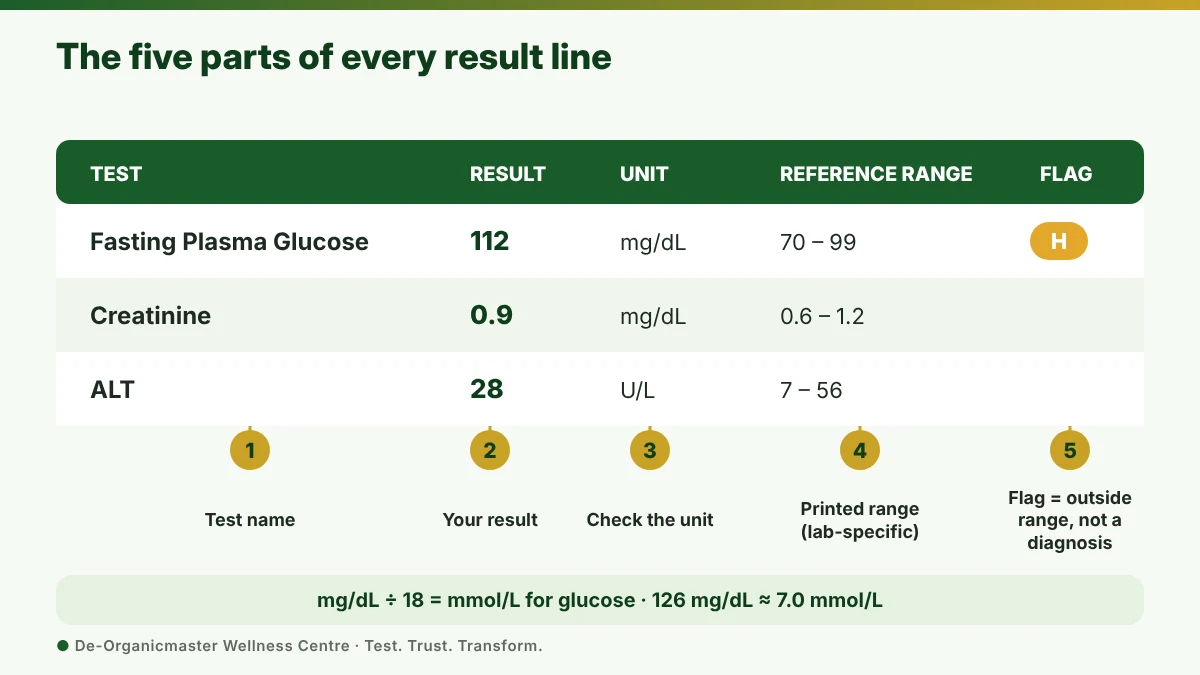
The five parts of every result
- Test name. For example, "Fasting Plasma Glucose", "ALT", "Creatinine".
- Your result. The number measured in your sample.
- Unit. Always check it. Blood sugar may appear as mg/dL or mmol/L. Dividing mg/dL by 18 gives mmol/L, so 126 mg/dL is about 7.0 mmol/L.
- Reference range. The interval in which most healthy people in the comparison group fall. It can differ between laboratories, ages and sexes, so always use the range printed on your own report.
- Flag. Often H (high) or L (low), sometimes an asterisk. A flag means "outside the printed range". It does not by itself mean disease.
What a flag does and does not mean
A slightly high or low number is common, particularly if you were unwell, dehydrated, had not fasted properly, or exercised hard the day before. Doctors look at the size of the difference, how it compares with your previous results, your symptoms, and other tests. One flagged result is a question. It is not an answer.
Tests worth recognising
| Test | What it is mostly used to look at |
|---|---|
| Fasting glucose, HbA1c | Blood sugar control (HbA1c shows roughly three months) |
| Total cholesterol, LDL, HDL, triglycerides | Blood fats and heart risk |
| Creatinine, eGFR, urea, urine albumin | Kidney function and early kidney damage |
| ALT, AST, GGT, bilirubin | Liver health |
| Full blood count (haemoglobin, white cells, platelets) | Anaemia, infection and clotting cells |
| TSH | Thyroid function |
| Sodium, potassium | Salt and mineral balance, relevant to blood pressure and some medicines |
Before the test: simple rules that improve accuracy
- Follow fasting instructions exactly. For fasting glucose and lipids, that normally means no food or sugary drink for about eight to twelve hours, with water allowed unless told otherwise.
- Tell the lab and doctor which medicines and supplements you take.
- Avoid heavy exercise and alcohol the day before unless told otherwise.
- Where possible, use the same laboratory for repeat tests so results are comparable.
Look at the trend, not only the page
Keep every report in one folder, in date order. Write the key numbers in a simple table. When you can see sugar, pressure, weight, kidney and liver values change over time, you and your clinician can tell whether you are improving, drifting or stable. This is also the best defence against the "normal, you may go" problem described in when your test is normal but you still feel unwell.
Questions to ask about any result
- Is this result outside the range, and by how much?
- What could explain it, and does it need repeating?
- Does it fit with my symptoms?
- Which other tests should be read alongside it?
- What, if anything, should I change now, and when do we check again?
Frequently asked questions
What does the H or L next to my result mean?
H means higher and L lower than the printed reference range. It does not automatically mean disease. Your doctor interprets it with your symptoms and history.
Why do two laboratories give different ranges?
Methods, equipment and the populations used to set ranges differ. Always compare your result with the range printed on the same report.
How should I convert glucose units?
Divide mg/dL by 18 to get mmol/L. For example, 126 mg/dL is about 7.0 mmol/L.
This article is educational and does not replace advice from your doctor. Please do not stop or change any prescribed medicine without speaking to the person who prescribed it.