

Taking an active role in your health without leaving your doctor behind
29 Oct 2026 · 4 min read
There are two extremes in how people deal with their health. At one end is the patient who hands everything to the doctor and asks nothing. At the other is the person who turns to the internet or a friend's advice and stops treatment. Neither tends to end well. There is a third path, and it is the one we encourage: an engaged patient who works with the clinical team.
What an active role is not
- It is not stopping medicines because you feel better, or because a relative says they are harmful.
- It is not diagnosing yourself with search engines or social media posts.
- It is not rejecting hospital care in favour of unproven remedies.
What an active role is
It is the daily and monthly habits that make your doctor's work easier and your results better. We like to describe them as four steps that repeat.
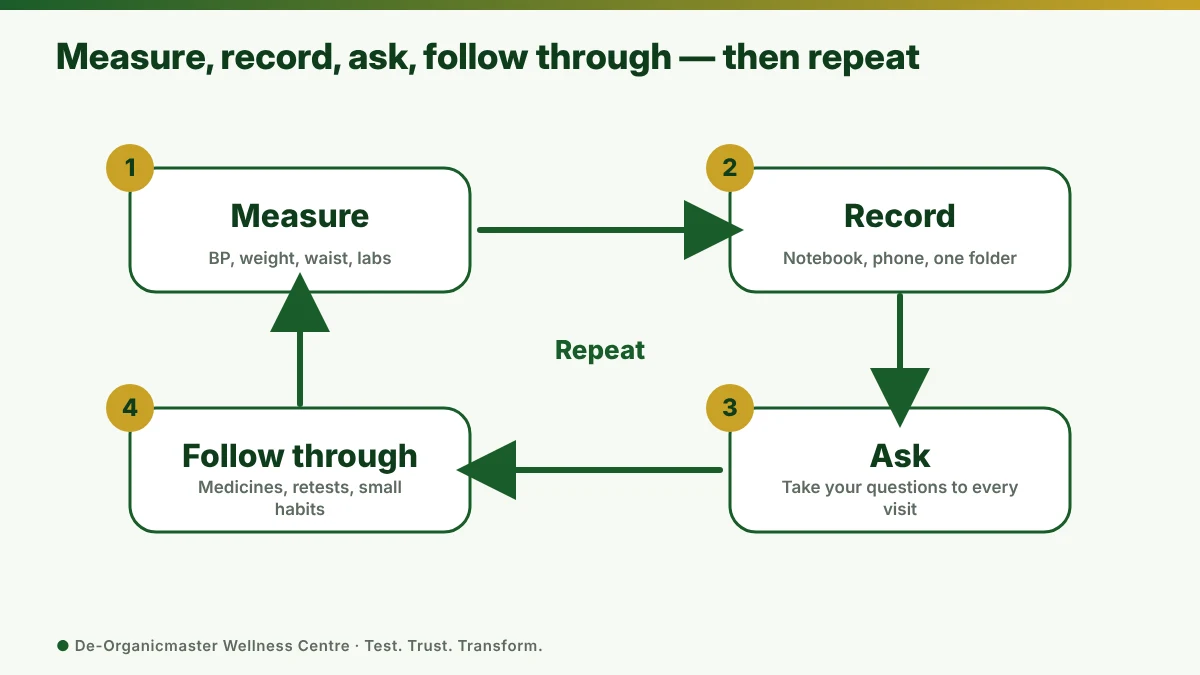
Step 1: Measure
Know a few of your own numbers. For most adults, a good starting set is blood pressure (see how to measure it properly in our blood pressure guide), weight, waist circumference, and, where advised, home blood sugar. Add a periodic lab panel to see the rest, such as HbA1c, blood fats, liver and kidney tests.
Step 2: Record
Numbers you do not write down are numbers you forget. Use a notebook or phone note. Record date, reading, how you felt, what you ate if relevant, and any medicine changes. Keep every lab report in one folder. After a few months you have a personal health story that no single clinic can see.
Step 3: Ask
Take your records and your questions to every visit. Our list of ten questions for every hospital visit is a good start. Ask what the numbers mean, what the target is, and what the plan is if things do not improve.
Step 4: Follow through
Care works when the plan is followed: taking medicines as prescribed, attending follow-ups, repeating tests on time, and changing one or two habits at a time. The most common reason treatment disappoints is not the wrong prescription, but a plan that fades after a few weeks. Small, specific commitments last longer than dramatic promises.
Start small
| Week | One thing to do |
|---|---|
| 1 | Gather all your old results and prescriptions into one folder |
| 2 | Measure home blood pressure morning and evening for seven days |
| 3 | Swap one sugary drink a day for water, and add one vegetable portion to your main meal |
| 4 | Book a check-up, bring your log, and ask the key questions |
Support makes it easier
Habits stick better when someone is with you. Tell a family member what you are working on. Join a group or programme that keeps you accountable. Many of our members find that checking in daily, even for ten seconds, is what keeps the routine going.
A partnership, not a rebellion
The point is not to need your doctor less. It is to make every minute with them count. Informed patients tend to catch problems earlier, understand their treatment better and feel more in control. That is what we mean in our book by taking an active role in your own health, while still standing on the shoulders of good medical care.
Frequently asked questions
Does taking an active role mean I do not need my doctor?
No. It means you work with your doctor by measuring, recording, asking and following the plan. It does not replace professional care.
What should I measure at home?
For most adults, blood pressure and weight are a good start. Blood sugar monitoring is for people advised to do so. Ask your doctor what is right for you.
How do I stay consistent?
Pick one small habit, attach it to a daily routine, write it down, and involve a friend, family member or group for support.
This article is educational and does not replace advice from your doctor. Please do not stop or change any prescribed medicine without speaking to the person who prescribed it.